Some of the best nights out start with a simple question: what's happening near me, right now?
Sympla couldn't answer that question. Discovery was list-based — structured, searchable, but fundamentally passive. You had to know what you were looking for to find it. For spontaneous decisions — especially high-energy moments like Carnival weekend — that model failed. The opportunity was clear: a location-first, real-time discovery mode that met users where they actually were, both physically and emotionally.

Discovery & Validation
Research and data pointed to three converging signals:
User interviews surfaced consistent friction: users wanted to explore by proximity, not just by keyword or category
Support and analytics revealed confusion and low engagement in the browsing flow, particularly during high-demand periods
Competitive benchmarking showed location-based discovery as an underexplored differentiator in the event space
Early validation included mockup tests, data analysis, and "fake door" experiments to measure intent before committing to full development.
Solution Design & Prototyping
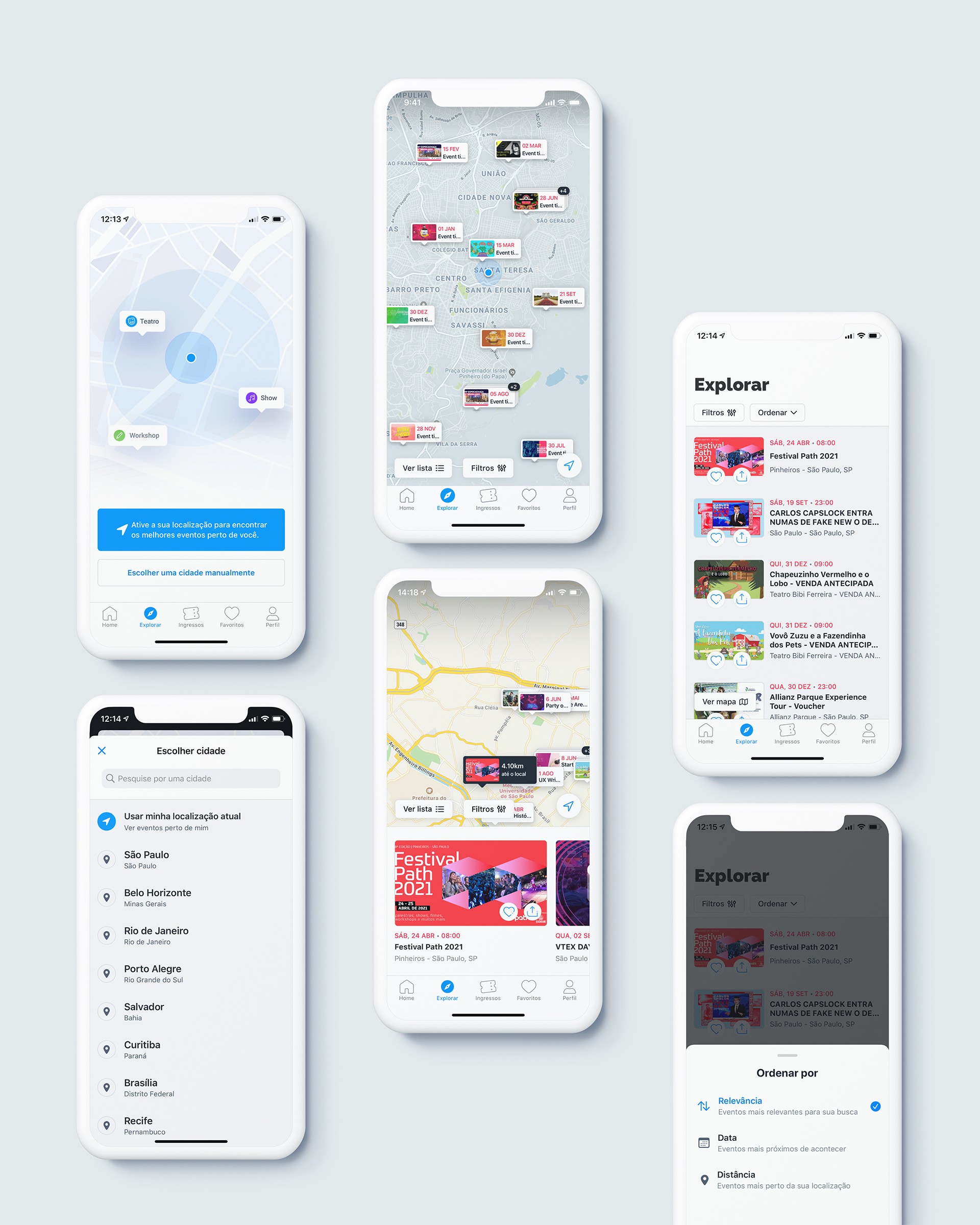
The Events on Map feature introduced a spatial layer to discovery:
Map view showing events by proximity, switchable to list view with a single tap
Event cards surfaced directly on the map with key details accessible without leaving the view
Filters by date, price, category, and distance
Deep integration with Carnival campaign to maximize impact during the highest-traffic moment of the year
The interaction model was deliberate: low friction, high contextual relevance. Users shouldn't have to think — they should just see what's around them and decide.
Testing & Iteration
Usability tests with 10 users confirmed the navigation model was intuitive. Key findings:
All users completed discovery tasks successfully
Navigation between map and list felt natural with no instruction needed
Microcopy and filters were refined based on feedback before launch
Post-launch: monitored adoption rates, support ticket reduction, engagement growth, and CSAT. Iterated based on real-world usage patterns.
Results
Metric | Impact |
|---|---|
Last-minute ticket sales — Carnival | +40% vs. previous year |
Daily active users on map view | +28% growth |
Drop-off between discovery and purchase | −22% |
Rank in browsing modes | Top 3 in the app within 3 months |
My Role
I led the full experience design — from the initial user research and competitive benchmarking, through IA definition, interaction design, and prototyping, to usability testing and final visual design across iOS and Android. I defined the product vision for the feature, aligned it with Sympla's business goals, and drove it through A/B testing and phased rollout.
What this taught me
The best features solve for emotion, not just function. A map view is technically straightforward — the real design challenge was understanding when people want to explore by location and building an experience that matched that state of mind. Carnival wasn't just a launch window; it was a proof of concept for a fundamentally different mode of discovery.